Problem
UAE federal agencies managing public safety operations — civil defence, police patrol, traffic enforcement, and impound operations — were running disconnected systems with no unified operational picture. Incident response depended on manual coordination across siloed data sources, creating blind spots in coverage, delays in dispatch, and no cross-agency audit trail.
Each agency’s field infrastructure ran different hardware, different protocols, and different update rates. There was no shared data model, no event backbone, and no mechanism for one agency’s operational state to inform another’s response in real time.
Approach
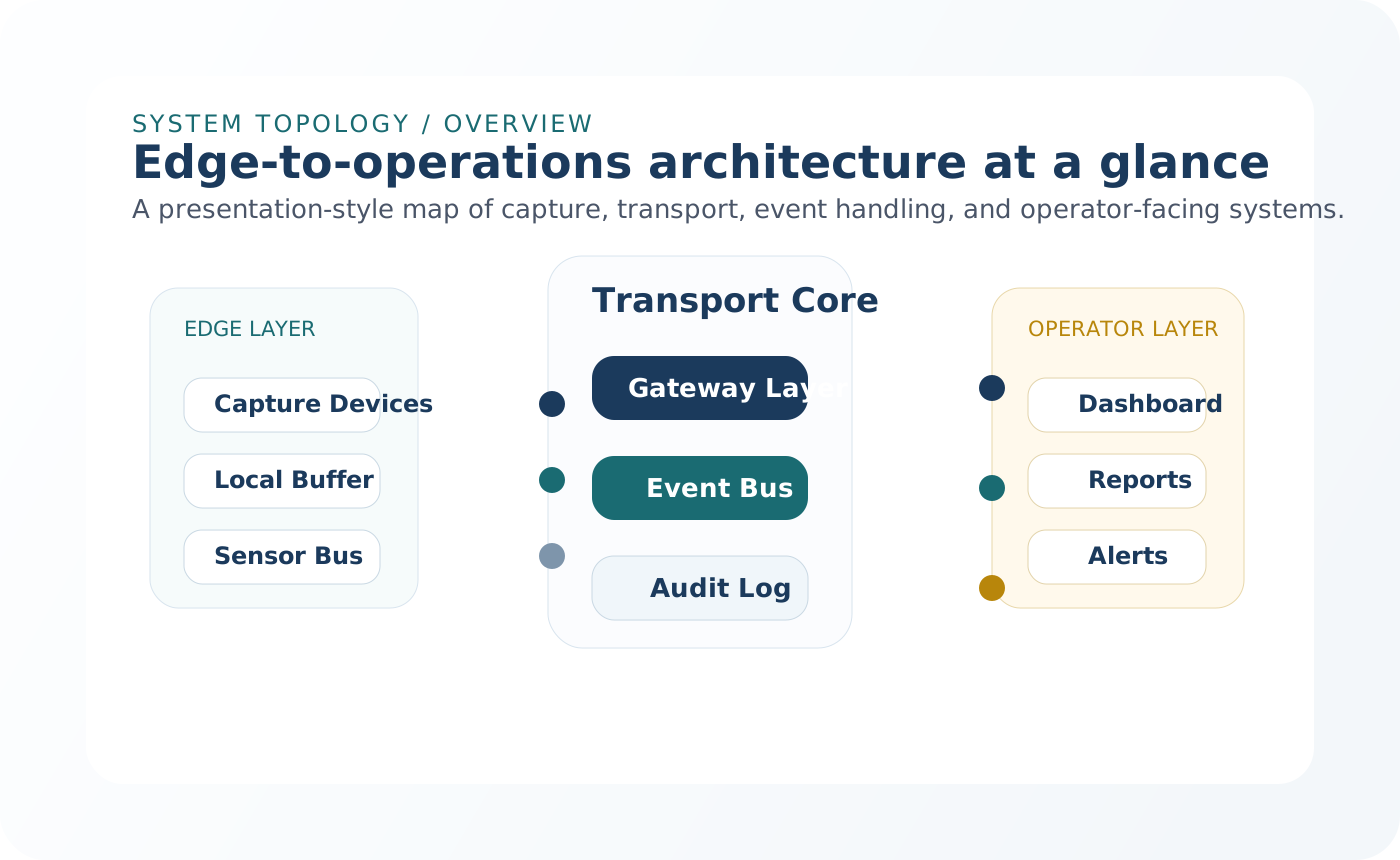
Architected a unified Safe City platform connecting heterogeneous government IoT infrastructure under a single real-time operational layer. Designed a Kafka-based event-driven ingestion architecture to normalize telemetry from 4,150+ tracked vehicles, 6,000 impound devices, ANPR camera networks, and smart parking sensors — each running different protocols and update frequencies — into a canonical data model consumed by agency-specific dashboards.
Built edge buffering on all GSM-connected field units so telemetry gaps never occur during connectivity loss. Underground parking, tunnel crossings, and low-coverage rural zones all produce intermittent signal; the platform maintains a continuous audit trail regardless, with buffered events flushing in order on reconnection.
Implemented per-agency Kafka consumer groups enforcing data access boundaries between civil defence, police patrol, and traffic units at the infrastructure level — not the application layer. Access is structural, not a permission check that can be misconfigured. Integrated an AI/ANPR pipeline for automated violation detection and an embedded-sensor-based driver assessment system across 55 field vehicles, processing test results with full offline resilience during assessments.
Led a team of five engineers across embedded firmware, backend services, and frontend delivery — responsible for architecture decisions, sprint planning, and direct technical delivery on all platform components.
Outcome
A live operational platform serving multiple UAE federal agencies simultaneously — 10,000+ connected devices, 300,000+ AI-assisted assessments processed across two emirates, 25% efficiency improvement in driver licensing operations, and real-time law enforcement visibility across civil defence and police fleet assets.
The platform established a repeatable architecture pattern: any new device type or agency can be integrated by adding a normalization adapter and a Kafka consumer group — the core ingestion and audit infrastructure does not change.