Case Study / Smart City

Engineering Work

Distributed Edge AI for Driver Behaviour Assessment at Scale

Running reliable AI and ANPR inference across distributed embedded edge units in moving vehicles, then aggregating results into a unified government platform with no tolerance for lost assessments.

300,000+ Assessments processed
55 Edge-AI vehicles deployed
50°C Operating temperature ceiling

Problem

How do you run reliable AI and ANPR inference across embedded edge units operating inside moving vehicles, under harsh summer temperatures, with intermittent cellular connectivity, and still deliver a legally auditable result stream into a centralized government platform?

The design problem was not just inference accuracy. It was about preserving trust in the system when vehicles moved through poor coverage areas and when field hardware had to keep operating without a technician standing by.

Approach

  • Chose edge-local inference over cloud inference because connectivity loss at road speed makes round-trip inference unreliable.
  • Designed a deterministic local buffer so assessments could queue offline and flush in order when links recovered.
  • Used device-type-specific Kafka topics to let ingestion, processing, and audit pipelines scale independently.
  • Separated real-time telemetry on MQTT from audit-grade event streams on Kafka because the latency and reliability requirements were not the same.
  • Added dead-letter handling so failed events could be reviewed without stalling the live assessment pipeline.

Outcome

The deployment processed more than 300,000 tests inside two years and contributed to a 25% operational efficiency gain versus the legacy process. Most importantly, it proved that edge intelligence and central auditability can coexist when connectivity is variable.
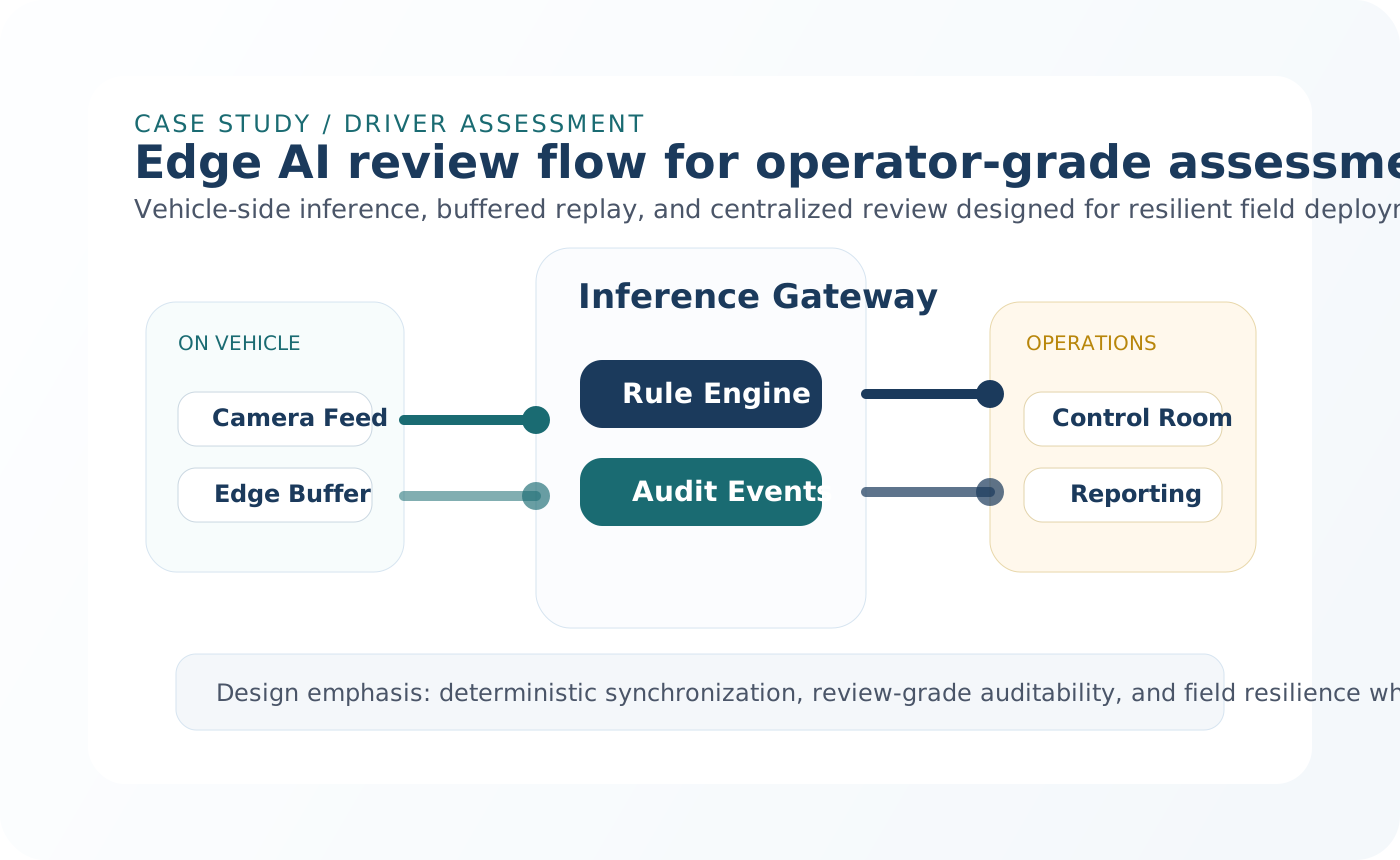
Architecture

System design shown as an operational topology, not a decorative diagram.

The architecture visual is intended to show how edge capture, buffering, transport, event processing, and operator-facing systems fit together under real deployment constraints.

Driver Assessment Flow

Distributed Edge AI for Driver Behaviour Assessment at Scale

On-vehicle inference, buffered synchronization, and auditable downstream review in one deployment view.

Architecture diagram of the driver assessment system showing edge AI units in vehicles, local data buffering, cellular uplink, Kafka event pipelines, audit logging, and government dashboards.
Distributed Edge AI for Driver Behaviour Assessment at Scale

What to look for

  • Offline resilience and deterministic recovery are treated as first-class design concerns.
  • Operational visibility is separated from ingestion reliability so reporting never destabilizes capture.
  • Protocol choices reflect topology and failure modes, not just team familiarity.
300,000+ Assessments processed
55 Edge-AI vehicles deployed
50°C Operating temperature ceiling

What I Would Do Differently

Invest earlier in a hardware-in-the-loop test bench that simulates both thermal stress and packet loss. Early field issues were heat-related and could have been reproduced sooner with a more production-faithful lab setup.

Stack

The implementation choices below reflect the boundary between field reliability, event architecture, and operator-facing systems.

Edge AI ANPR Kafka MQTT NestJS Angular