Problem
How do you design sensor nodes that measure feed, water, temperature, and CO₂ in remote agricultural locations when there is no grid power, no guaranteed cellular link, and no technician available to reset a failing unit?
This was as much a power-systems problem as an embedded-software problem. Sampling frequency, radio choice, fault recovery, and energy harvesting strategy were all coupled design decisions.
Approach
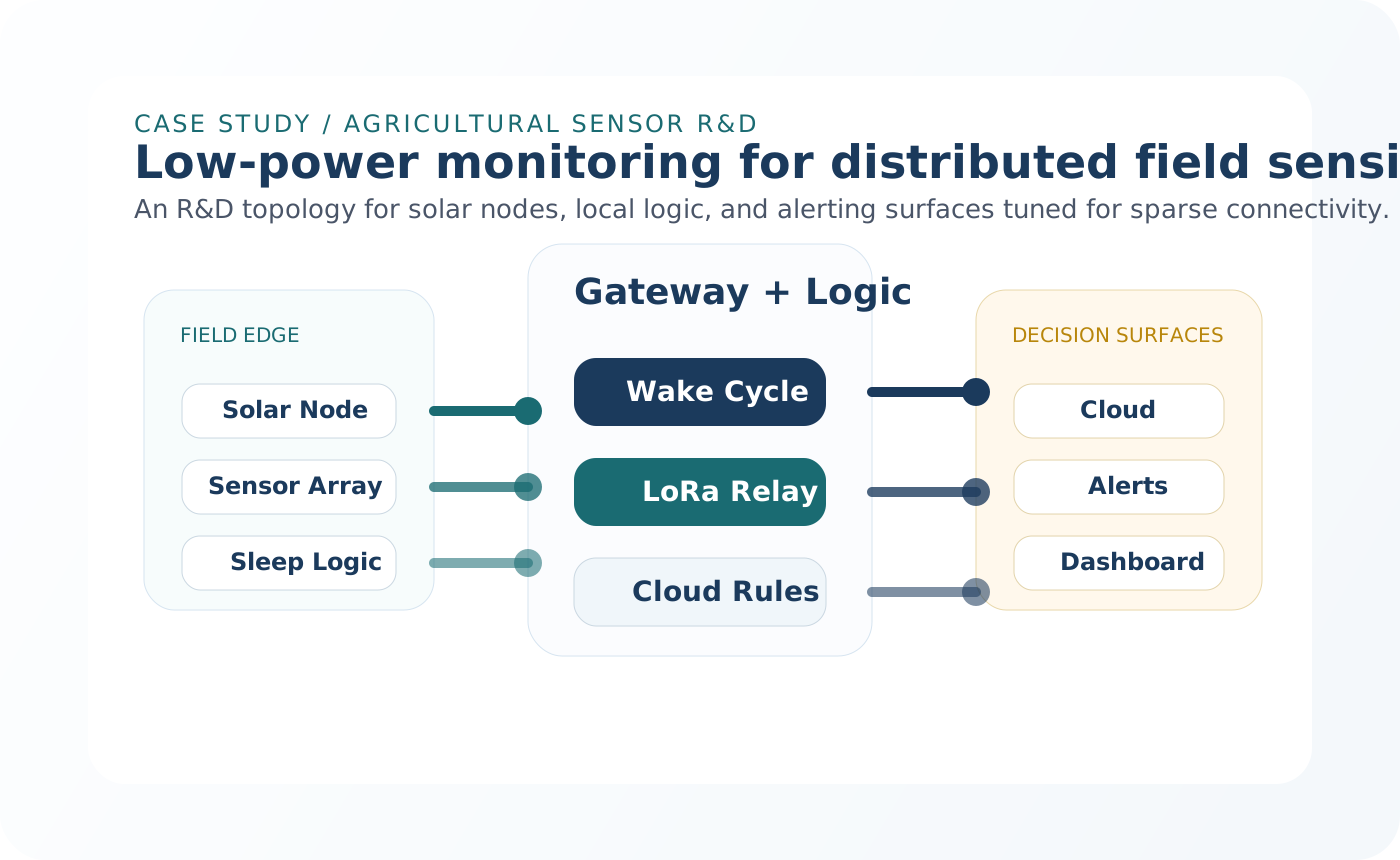
- Designed adaptive sleep and wake scheduling based on battery state to extend useful runtime under poor solar conditions.
- Chose LoRa over GSM as the primary uplink because power draw and range mattered more than familiar tooling.
- Added local threshold logic so nodes could suppress routine transmissions and spend energy only when events mattered.
- Integrated maximum power point tracking to recover more solar harvest than a naive charging design.
- Used watchdog-driven recovery so firmware stalls did not require field intervention.
Outcome
The sensor system demonstrated that unattended, off-grid sensing is reliable when power management, radio topology, and recovery strategy are designed together. Units operated for multiple months without field intervention across Italian vineyard and orchard sites.
The field sensor network fed into a full multi-tenant SaaS platform built to aggregate, visualise, and alert on the collected data across multiple commercial clients:
- Chose Kafka over direct MQTT subscription for data ingestion — it decouples ingestion from processing, supports multiple independent consumers per client, and allows historical replay if a processing consumer falls behind.
- Used MQTT topic namespacing by device identifier and client prefix, so all clients share one broker without ever seeing each other’s data streams.
- Built a modular Angular dashboard with a drag-and-drop widget system — each client account configures their own layout without code deployment; widget types include time-series charts, threshold gauges, and device status maps.
- Implemented role-based access control at device level — a user account can be scoped to a specific site or device group, not just a top-level tenant.
- Used Redis for real-time device last-seen state and session caching; MongoDB as the primary data store for telemetry history and device configurations.
The platform went live serving commercial agricultural clients across Italy and Europe — demonstrating the full vertical from firmware to deployed SaaS in a single engineering effort.